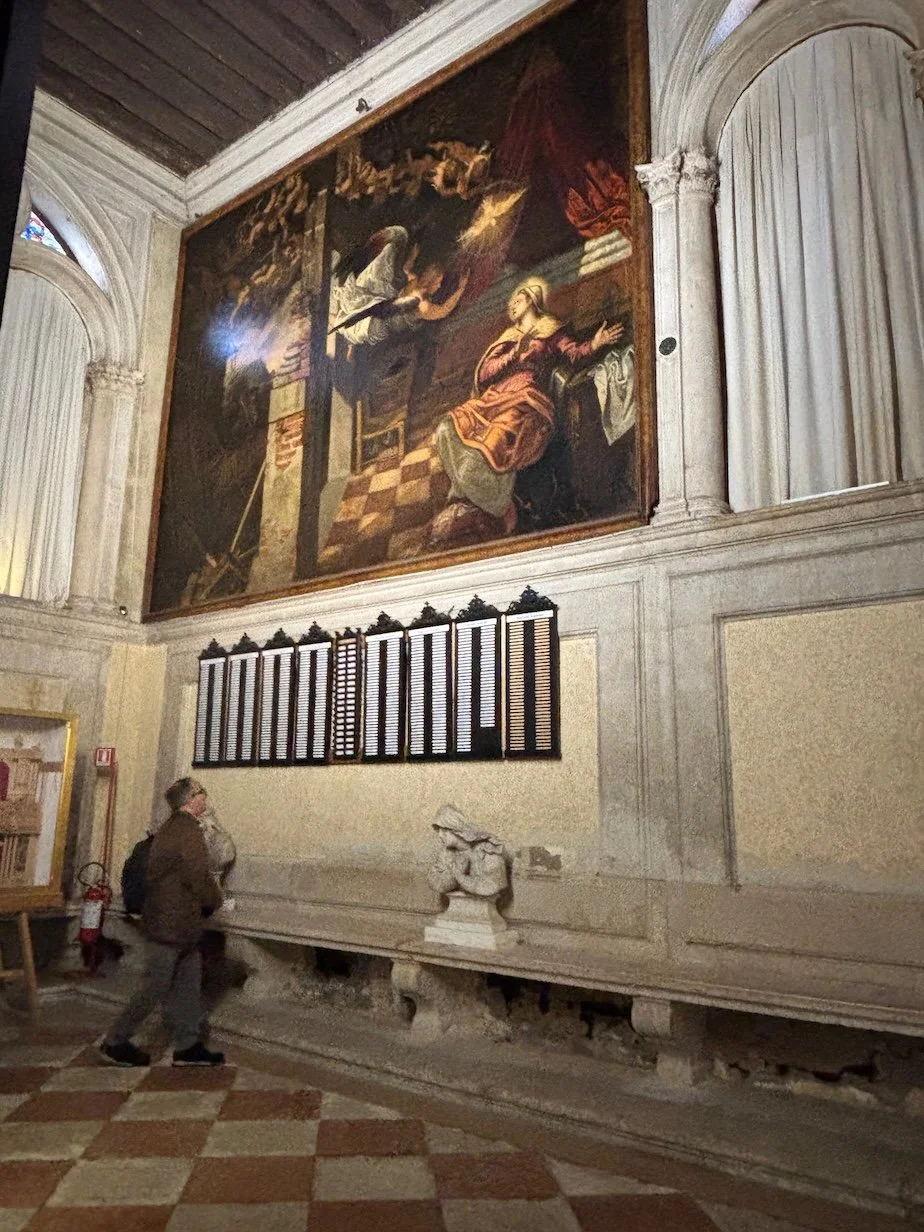
Tintoretto, The Annunciation, Scuola Grande di San Rocco, Venice.
Photo by Trebbe Johnson
November 23, 2026
Recently I saw a painting that made me think about how miracles work in everyday life.
I was in Venice. I had a few reasons for going there, and one of them was to study the works of the Late Renaissance artist, Tintoretto (1518-1594). What I love about his work is the theatricality with which he imbues his canvases, whether their themes are religious (the majority), mythological, or portraits. Every figure is engaged in some specific task or reacting emotionally to some event.
Because he was a native of Venice and an aggressively ambitious artist besides, Tintoretto’s work appears throughout the city in numerous churches and scuole, meeting places for guilds or confraternities devoted to a specific trade, ethnicity, or aim. On my first morning in Venice, I followed the labyrinthine passageways to the Scuolo Grande di San Rocco, dedicated to the saint, who was supposedly cured of the plague and whose scuola members devoted themselves to helping the sick.
The building is filled with Tintoretto’s work, but the painting that grabbed me and won’t let go is the Annunciation. It features only two main figures: the Virgin Mary and the archangel Gabriel who comes to tell her that she will bear the child of God.
Unlike many versions of the Annunciation, this one does not depict a politely tiptoeing angel and a shy and humble Mary. This angel, accompanied by an arc of cherubs, appears to be crashing into the room. Mary gapes at him in alarm. Whatever is happening, she’s not at all sure she’s going to like it. She sweeps her arms to one side, almost as if she’s trying to shoo the angelic host out of the room.
What is also remarkable is that Tintoretto seems to have determined that his version of the Annunciation would take place in the very building in which he was working. Although Mary is sitting on a simple chair, the floor is constructed of the same red-and-white checkerboard slabs as those in the scuolaitself, while the ceiling resembles the gilded wooden ceiling on the upper floor of the building.
It is as if Tintoretto is saying: Miracles can happen anywhere. Look! They may be happening right in front of you!
Standing before this painting on a November morning, with sunlight at my back and the prospect of seeing many extraordinary works of art in the days to come, I couldn’t help reflecting on the nature of miracle, as, I suspect, Tintoretto hoped that witnesses to his painting would do.
What are the miracles that thrust themselves at us each day?
That we exist…
That love is activated in so many ways…
That Tintoretto not only survived the plague but fiercely painted his way right through it…
That certain avocations, passions, places call to us because they hold keys to our soul’s very existence…
… and that, when we dare to enter the portals those keys make accessible, we discover beauty, magic, and joy, even in the midst of suffering.
It was a miracle that I, a twenty-first century woman, could stand before this work and glean something of the sensibility of the artist who lived almost five hundred years earlier.
The angel of miracle is waiting to crash in and astonish us. We will be wise—as Mary ended up being—to welcome the interruption of the ordinary and ask what it has to teach us.
UPCOMING PROGRAMSLast February twelve aspiring writers gathered on Zoom with my friend and colleague Lauren Chambliss and me. Each of them had long wanted to write about some aspect of their life. A few had very specific ideas about their subject, but just didn’t know how to focus it. A couple had actually started their project, but hadn’t been able to follow through. Most had only a vague idea about what they wanted to explore.
By the time of our ninth and final session in November, each person read an excerpt from their piece to the group. Each and every story was so good, so gripping, so rich in imagery and pacing that I was absolutely floored.
Starting on February 16, 2027, Lauren and I will begin leading a new online version of WRITING THE STORY OF YOU.
If you or someone you know has a story that keeps pushing to be told, do sign up for our program. You will be amazed at what happens!
For more information, cost and a brief outline, see my website.
WHAT I’M READING
In my climate change book group here in Ithaca, we read Stephen Markley’s Deluge earlier this year. I thought it the most remarkable book—a lengthy tome interweaving the stories of eight or nine people who are in some way engaged in reducing, fighting, educating, profit from, or trying to ignore the harsh realities of global warming. I liked the book so much that I have begun reading Markley’s earlier novel, Ohio. It tells the stories of five people struggling to get by in a small Ohio town. The author’s ability to penetrate the minds of his characters is remarkable.