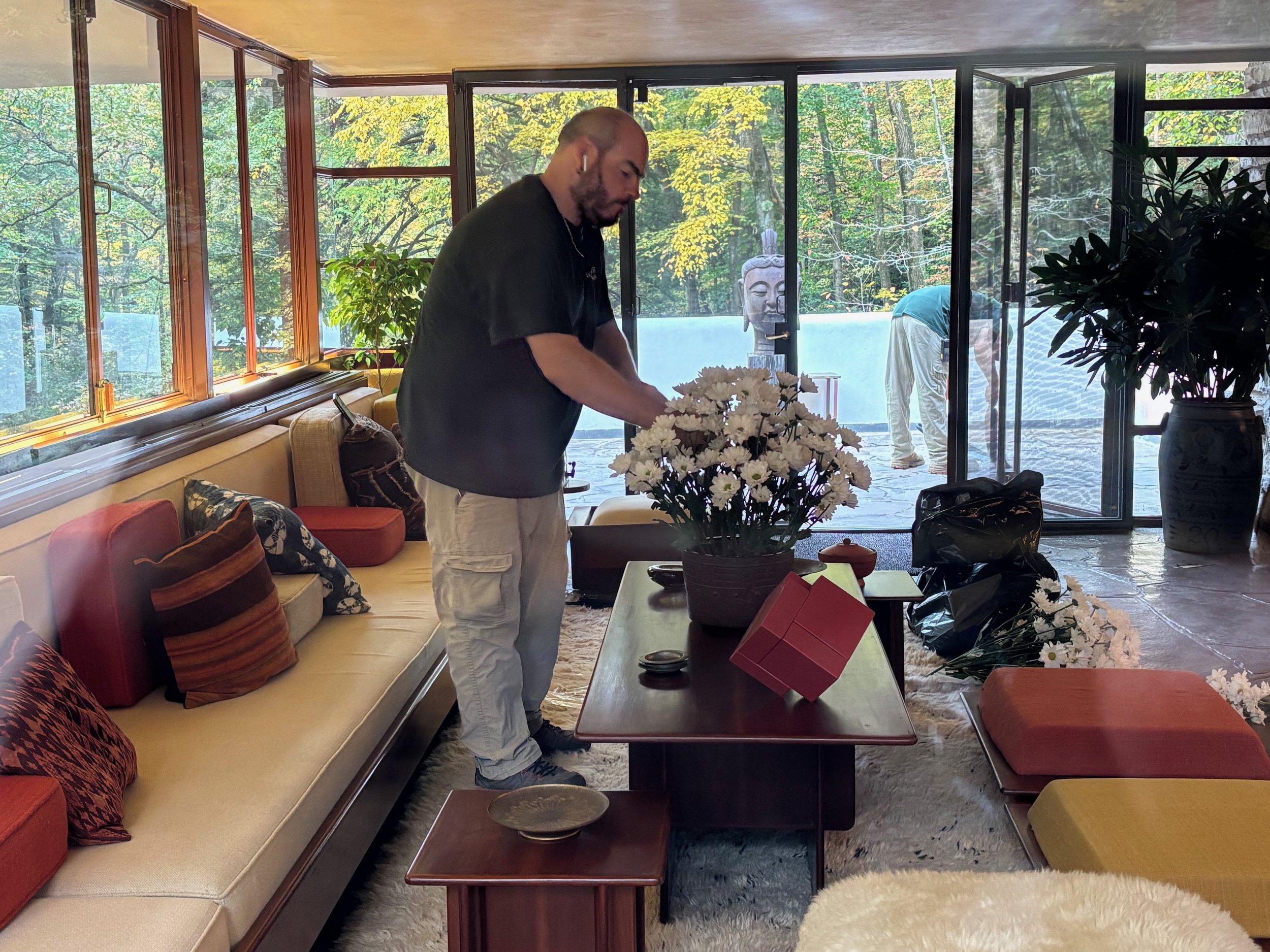
Fallingwater groundskeeper Scott arranging flowers in the living room
October 29, 2026
Consider the quests in so many fairy tales. The seeker who succeeds in the end is the one who pays attention to those she meets along the path, the ones others (often her selfish, wicked siblings) are likely to ignore. It’s the frog, the ant, the old woman drawing water from the well who guides the heroine or hero forth.
I often find that wisdom to be true in life. The people I need to meet to help me along are not always the obvious ones.
Take my recent trip to Frank Lloyd Wright’s beautiful Fallingwater, a private house completed in 1937 in southwestern Pennsylvania for the E.J. Kaufmann family. Fallingwater has commanded attention worldwide ever since, for it is a master work of architecture aligned with extraordinary skill over and around a waterfall. It is human and nature, art and geology, modern and timeless.
I’d wanted to see it since I first read about it when I was sixteen. So, two weeks ago, after leading a grief retreat in Racine, Wisconsin, I drove to Pennsylvania and stayed Tuesday night in an old hotel nearby.
On Wednesday morning, I arrived at the Fallingwater gate at 8 AM—only to find out that that was the one day of the week it was closed. I couldn’t drive down the long entrance road, but there were no signs warning against trespassing, so I slipped around the gate and walked in.
The narrow road led about ¾ mile through the woods to an open-air hexagonal visitors center with a café, museum, and gift shop opening off to the sides. There was no sign of the house, so I went back to the woods and kept walking along the narrow paths. Finally I encountered a young man who told me he was the artist-in-residence. I expressed my admiration for such a position and asked how to get to the secluded house. He pointed the way and warned me not to get close or the security cameras would find me and “the guard will come and try to bust you.”
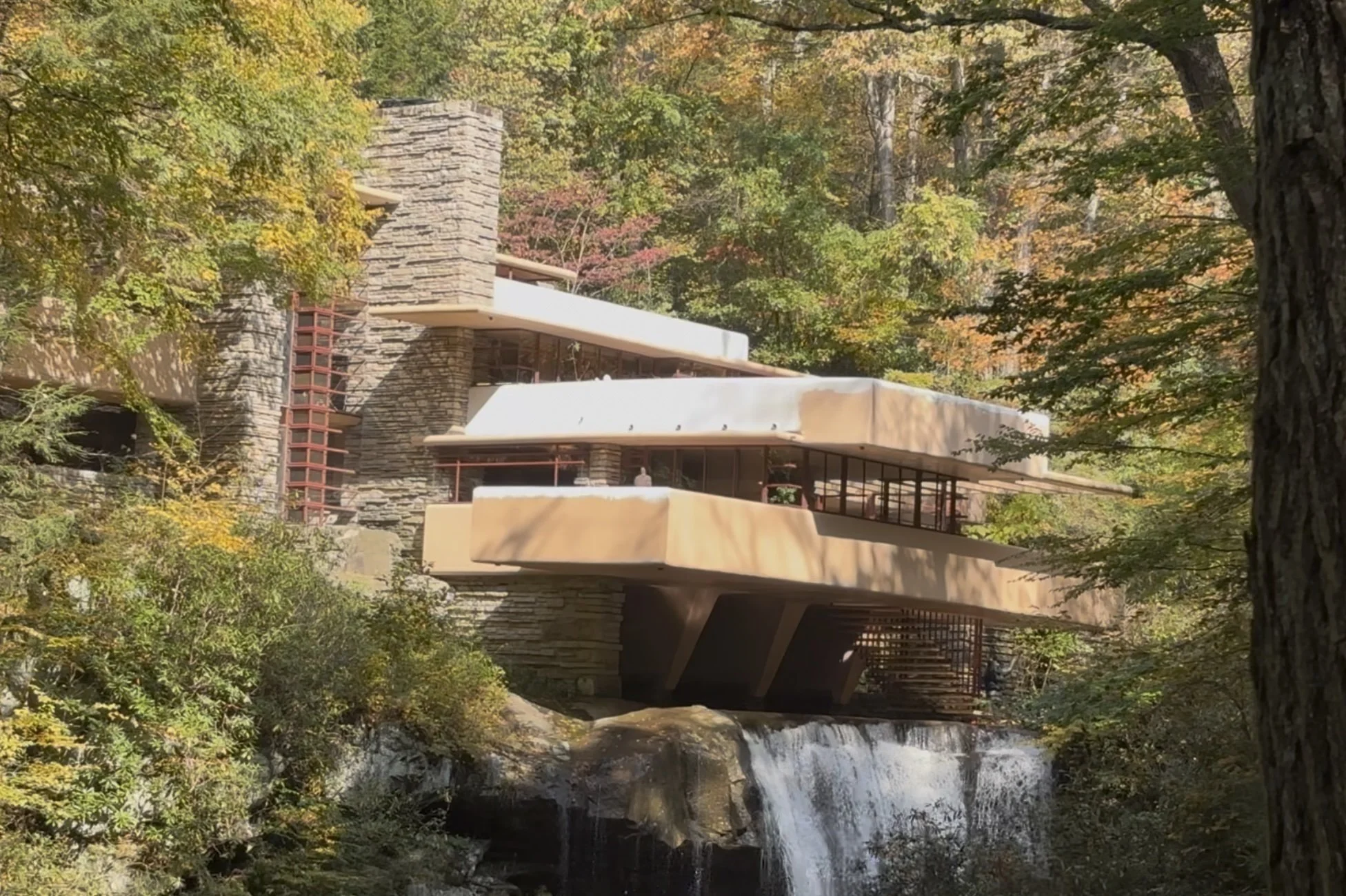
At my first glimpse of this iconic building, I gasped out loud. All outrageous horizontals veering out into space and a foundation that hugged the rocks and the waterfall, it seemed almost a living thing. It respected all the details of the terrain, yet insisted, Human-made contributions are welcome here. Following the artist’s advice, I walked circles through the woods, studying the house from all directions.
When I got back to my car, I discovered the security guard standing at the gate.
“Did you have a nice walk?” he asked?
It occurred to me that there were probably more security cameras than I had assumed, and that he’d had an eye on me for much of my peregrination.
“I did,” I told him, and since he seemed more open to a conversation than in “busting” me, I told him how eager I had been to see the house, and how I admired Wright’s genius in creating a building that, while emerging harmoniously from its environment, didn’t try to hide its constructed presence, but expressed it in dialogue with the environment.
“I’ll come back tomorrow,” I told him.
He informed me that, in order to enter the house, you have to take a tour, and they’re booked weeks in advance. But, he said, “You could come early and walk around and peek in the windows.”
I thanked him, and that’s what I did when I returned on Thursday morning, for, as he had predicted, there was no tour available for almost a week. Mine wasn’t the first car to go through the gate that day, but it was one of the first. And now, since I knew exactly how to get to the house, I walked right to it, as the other early morning visitors browsed in the visitor center and waited for their tour to begin.
For almost an hour I went up and down the outer stairs, peered into the windows, even stood on a rock to get a better look into the high windows of the kitchen. Because my views were limited, I remained long at each vista, so as to absorb every possible detail.
In the living room, a man was arranging flowers in a vase. How touched I found myself by his presence. There he was, a contemporary human, perhaps in his mid-forties, adding fresh beauty to this storied place. He saw me watching and waved, and I took his picture.
A little later I met him again on the path. I told him how struck I had been to witness his work with the flowers. His name was Scott. He told me he had been the keeper of the grounds for seven years. I asked what he loved about his job. He described how the rain cascades like miniature waterfalls off the amber-colored overhangs. He loved the magic of Fallingwater in snow. Spring was his favorite time of year, he said, because the redbuds are in bloom, and he pointed one out to me just a few feet away, now shimmering in autumn with golden heart-shaped leaves.
I was sitting by the swimming pool when the first tour group arrived. They looked at me with puzzled frowns, probably unable to imagine who I was and how I happened to be there, apparently unsupervised and not employed at something useful.
It was a beautiful way to view this extraordinary house that has fascinated me for so many years. Guiding me were three people: the artist who advised me how to proceed without getting stopped, the security guard who gave me a tip on how best to see the house, and the grounds keeper who shared with me his own relationship the house. Three guides, none of them “official”. I had a wonderful time with Fallingwater.
(Photos of Fallingwater by Trebbe Johnson)
UPCOMING PROGRAMS
So many people dream of one day writing the story about some aspect of their life that has shaped them, guided them, challenged them.
This year my friend and colleague Lauren Chambliss and I guided a dozen aspiring writers to do just that on our 9-month online WRITING THE STORY OF YOU. As one participtant wrote us recently, “Now I know myself as a writer.”
We are thrilled to offer Writing the Story of You again, starting February 16, 2027. Click the link above to read all the details.
WHAT I’M READING
Of course, after my up-close engagement with Fallingwater, I wanted to read all the details. In the shop in the visitors center, I bought a book, Fallingwater Rising by Franklin Toker. It is wonderful. Toker probes the relationship between Wright and his client, E.J. Kaufmann; discusses the challenges of building a house over a waterfall; compares Wright’s design aesthetic with that of other architects of the time; and even explores the levels of impact the house made when it was completed in the middle of the Depression. I will be sad to finish this book and to say a second goodbye to beautiful Falllingwater.